Why bother about the Earth System and decentering the human?

Updated: Nov 14, 2023
It’s Tuesday, 31st of October. I am in my office, sipping black tea from a mug hand-painted in Turkey and bought from a local T.J.Maxx store. The darkness sets in, and shortly after, snowflakes start dancing in the air. Snow? In October? An hour later, the sun is shining again. In the afternoon, the story repeats. This time with a snowstorm, resulting in snow sticking to roads and pavements. This has been one of the coldest Halloweens on record in Chicago. As for me, it was the earliest snow of the season I have ever experienced. I am glad it has not snowed since.

On a rather chilly night before Halloween, I attended a discussion led by Linda Zerilli on Dipesh Chakrabarty’s new book One Planet, Many Worlds. The book has been previously described as “the best available introduction to the new challenges for political thinking in the Anthropocene”. Chakrabarty invites us to rethink the relation between human and natural history: the globe as a human construct and a complex earth system that decenters the human. The latter has agency on its own. The agency of the earth systems is reflected in global warming and climate change. These force us to consider the planet beyond being a reserve of raw materials.

As reflected in the book’s title, Chakrabarty also addresses the tension between one and many, planet and society, as well as their unavoidable entanglement. Human and non-human are entangled biologically and technologically, both in modernity and modernization. Chakrabarty’s twist of words can wonderfully illustrate this. For example, India and China play geopolitics. But they don’t play geologically informed politics. Chakrabarty also calls for future conception of politics that will need ‘to consider the health of the Earth without the constraints that the welfare of humankind comes first’ (Chakrabarty, p. 65). Are we ready for this?

The tension between one and the many is also between cultural (or any other differences). They should be seen as a resource rather than a limit, despite the unavoidable tension between the two. Chakrabarty sees human sciences as a description of what sciences do. According to him, this brings more truth than science. In another roundtable, he was questioned whether academia needs to be re-made to be able to respond to the problems at hand by moving away from knowledge. Chakrabarty acknowledged that change is already happening. He highlighted the shift towards interdisciplinarity and offering interdisciplinary courses to undergraduate students.

A wonderful example of how political change may uproot and change traditions, are Gaugas de pan, meaning bread dolls. This is a tradition that developed in Ecuador, in response to Spanish colonization. Before that, in pre-Inca times, communities residing in today's Ecuador, would unearth their dead and celebrate with them. They brought food to the graves, ate with the dead, and fed the dead. Sango, a special drink made of black corn and llama blood was consumed on the occasion and offered to the dead. It was an important holiday that honored the lives of ancestors and others who passed away. With the arrival of the Spanish conquistadors and the Catholic church, however, the tradition of unearthing the dead was prohibited.
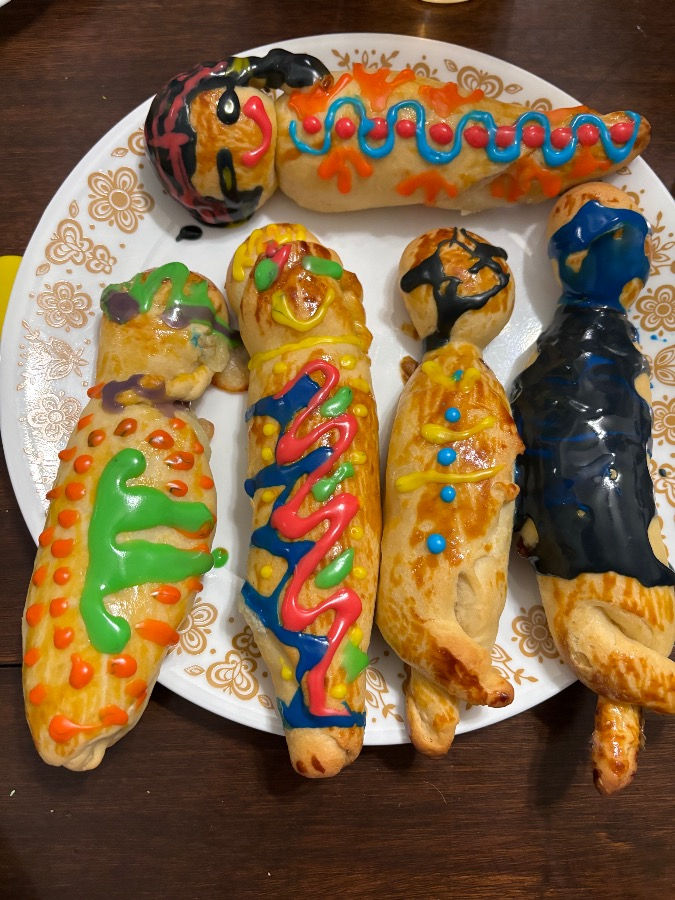
In response, new traditions evolved. I was fortunate to learn about the more recent Ecuadorian tradition of baking and decorating bread dolls, representing the ancestors, on the 2nd of November, on the day of the deceased, locally known as Día de los Difuntos. An Ecuadorian colleague generously shared her knowledge and traditions at her home with us. In a group of international colleagues, we painted and enjoyed the bread dolls and some Colada Morada, a drink that was known by the Incas as Sango. Apart from its off-putting bloody look, Colada Morada is a delicious, sweet drink made of black corn, fruits, and aromatic herbs. Coming from the land of (yellow) polenta, enjoying a red version of it in form of a red drink was a pleasant and unusual experience.

November, however, is not only the month for remembering the dead. Each November, the Field Museum celebrates the Native American Heritage Month. On November 1st, Oka Homma Singers and Native dance performers filled the Stanley Field Hall. In their last act, we got to join the Native performers dancing in a circle. Throughout the month, museum staff members and guest speakers will share their presentations about the objects and issues at the heart of Native histories and contemporary experiences.

The museum currently also hosts an exhibition Native Truths: Our Voice, Our Stories. The exhibition is special as it was co-curated by Native elders, community members, educators, artists, and scholars working at the Field Museum. The exhibition portrays the Calumet Region, a geographic area that encompasses the southern shore of Lake Michigan, spanning across Illinois, Indiana, and Michigan. At the same time, calumet also denotes a North American peace pipe. Other indigenous names for the Calumet region can be seen below.

Among several intriguing pieces on display, is a photo of Ethnic Children at Bailey Branch Library, taken in 1922. Blow the American flag, children hold banners with their personal identifiers. For example, reading from left to right: “Croatian, Spanish, Jewish, Lithuanian, Czecho-Slovanic, Russian, Italian, and Jugo-Slavic”. Interestingly, the “Jugo-Slavic” identity represented in this photo predates the Kingdom of Jugoslavija (1929-1941) as at the time, it was called The Kingdom of Serbs, Croats and Slovenes (1918-1929).

Apart from the exhibitions at the Field Museum, I was also fortunate to be guided around the museum of the Institute for the Study of Ancient Cultures at the University of Chicago. One of their best-known items on display comprises the human-headed winged bull (ca. 721-705), known as lamassu, from the site of Khorsabad in northern Iraq. A composite being with the head of a human, the body and ears of a bull, and the wings of a bird is of immense proportion and artistic skill. Luckily, the museum has not yet been fully built when the fragment has been brought in through a hole in the wall.

Remember Chakrabarty’s take on the importance of interdisciplinary research? It is crossing boundaries between disciplines that interest me. The Field Museum is one of important localities for interdisciplinary research. Being integrated into The Negaunee Integrative Research Center, offers unlimited possibilities for interdisciplinary exchange. With experts in anthropology, meteoritics and polar studies, paleomammology, and bioinformatics, it is the prime location for exploring human and natural history that are inherently entangled and changing. Recently, the museum scientist showed that the Moon is 40 million years older than initially thought. Our Moon has formed 4,46 billion years ago when the biggest piece broke off the Earth. Could you imagine not having tides and days that are not 24 hours long? Without the Moon, it would be also impossible to experience a stunning Moonrise...


Comments